Romania as a Diplomatic Power of Proximity: From Defensive Security to a Doctrine of Dialogue
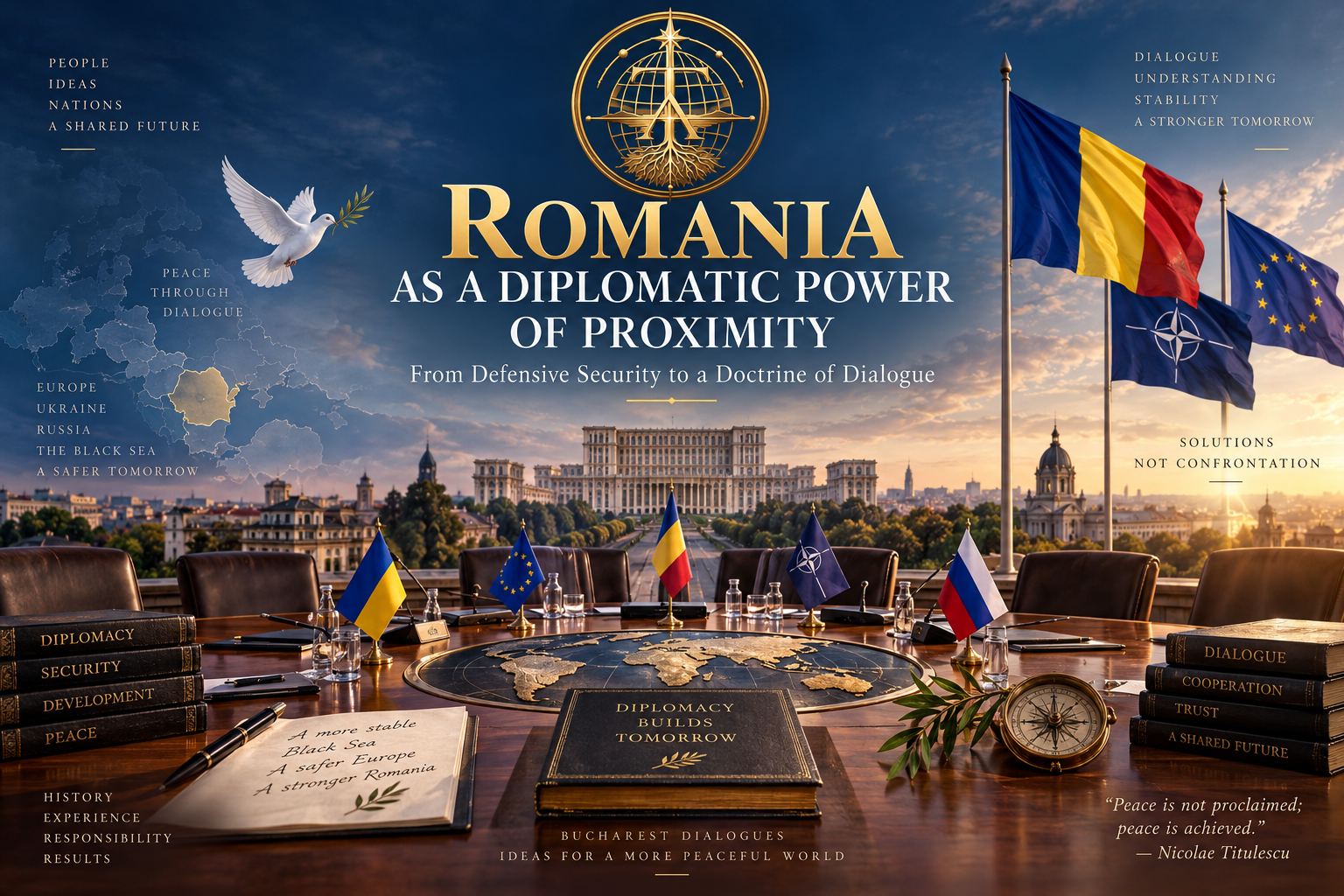

“Peace is not proclaimed; peace is won, and the efforts required for it to prevail are more difficult and more enduring than those involved in any other conquest.”
Romania does not need to choose between security and diplomacy. Its geography, NATO and EU membership, and direct proximity to the war in Ukraine create both a responsibility and an opportunity to become a producer of solutions, an exporter of expertise and a credible platform for international dialogue.
There are moments in the history of a state when geography ceases to be merely a circumstance and becomes a strategic obligation. Romania finds itself today in precisely such a moment. Its position on the Black Sea, its direct border with Ukraine, its special relationship with the Republic of Moldova, its membership in the European Union and NATO, its proximity to a war that has already lasted for more than four and a half years, and the profound transformation of the international system all compel Bucharest to move beyond an exclusively defensive or reactive conception of foreign policy. Romania must, of course, honour the commitments it has undertaken, strengthen its security, participate credibly in the political and military systems to which it belongs, and protect its territory and population. These matters are not negotiable in the everyday sense of the word, because they form part of the current strategic architecture of the Romanian state. Yet it is precisely this architecture that should provide Romania with the freedom and confidence to build something more: a foreign policy that does not merely absorb positions formulated in other capitals, but generates analysis, initiative, diplomatic formats and, above all, spaces in which parties to a conflict can continue speaking when dialogue becomes difficult.
What I am proposing does not imply a change in Romania’s external orientation, nor any form of neutrality between the alliances to which the Romanian state belongs and other centres of power. Such a discussion would begin from a false premise. Romania has been a member of NATO since 2004 and of the European Union since 2007; its security is now structurally connected to the Euro-Atlantic system, while its economy, legislation and a significant part of its institutional infrastructure are integrated into the European framework. A serious analysis of the advantages and limitations of the European Union is both necessary and legitimate and should be conducted separately, without idealisation and without demonisation, but the existence of dysfunctions does not cancel the strategic reality in which Romania operates. The real question is whether membership in these structures should turn Romania into a receiver of strategy or allow it to become a contributor to strategy. From my perspective, the answer is clear: a state that wishes to be taken seriously cannot remain indefinitely at the level of implementing positions developed elsewhere; over time, it must be capable of formulating positions of its own, compatible with its obligations but adapted to its geography, experience and long-term interests.
I. Security and diplomacy are not alternatives, but two components of the same state policy
In Romanian public debate, discussion of the war in the country’s immediate neighbourhood is too often organised around an artificial opposition: either security and firmness, or dialogue and peace. From a strategic perspective, this dichotomy is inadequate. Systems of collective security exist to reduce the likelihood of aggression and to increase the cost of possible confrontation, while diplomacy exists precisely to prevent situations in which military mechanisms must actually be used. A credible defence policy without diplomacy risks administering tension without reducing it; diplomacy without strategic backing risks, by contrast, being ignored. Serious states do not choose between the two. They seek to use them simultaneously.
This logic is embedded in the very legal architecture of the international order created after 1945. Chapter VI of the Charter of the United Nations is devoted to the peaceful settlement of disputes, and Article 33 provides that parties to any dispute whose continuation is likely to endanger the maintenance of international peace and security shall, first of all, seek a solution by negotiation, enquiry, mediation, conciliation, arbitration, judicial settlement, resort to regional agencies or arrangements, or other peaceful means of their own choice. This provision is important not only in legal terms but also philosophically: it does not assume that dialogue takes place only between actors who agree with one another; rather, it recognises that the existence of conflict itself creates the need to search for mechanisms through which that conflict may be managed and, ultimately, overcome.
In June 2026, the President of the United Nations General Assembly, Annalena Baerbock, brought this principle explicitly back to the centre of multilateral debate, stating that mediation lies at the very heart of the United Nations and recalling the obligation set out in the Charter to seek negotiation and other peaceful means before all else. The significance of this position is especially important in an era in which the language of confrontation is becoming more visible than the language of settlement: the international community did not create instruments of mediation for moments in which all sides already agree, but precisely for situations in which disagreement has become serious enough to generate or prolong violence.
The same perspective appears in Switzerland’s 2026 Chairpersonship of the OSCE. Ignazio Cassis, Switzerland’s foreign minister and Chairperson-in-Office of the organisation, recalled that the OSCE was born during a period of acute ideological confrontation and was designed for “dangerous times, not easy times”, which is precisely why dialogue and cooperative security are not luxuries but necessities. Documents issued under the Swiss Chairpersonship also contain a formulation that, in my view, deserves to be retained by any serious school of diplomacy: when diplomacy seems impossible, it becomes indispensable. In June 2026, Cassis explained that the value of the OSCE lies precisely in its ability to bring around the same table states that no longer speak to one another in other formats.
This is also the premise from which I believe Romania should proceed. Membership in NATO should reduce Romania’s strategic vulnerability, not its capacity for initiative. The more secure a state is in relation to its fundamental alignments, the more active it can afford to be diplomatically. Dialogue does not imply geopolitical equidistance, nor does it require abandoning alliances; it means recognising that security is not produced exclusively through the accumulation of military capabilities, but also through reducing the risk of miscalculation, preserving channels of communication, understanding the positions of others, and maintaining spaces in which differences can be discussed before they are transferred entirely into the realm of confrontation.
II. The Witkoff lesson: speaking to an interlocutor does not mean adopting his position
A recent episode in Kyiv offers, beyond any sympathy or antipathy toward current American policy, a very clear illustration of the difference between political judgement and diplomatic function. On 6 September 2026, after travelling to Moscow and holding talks lasting more than three hours with Vladimir Putin, American envoys Steve Witkoff and Jared Kushner went to Kyiv for discussions with President Volodymyr Zelensky and Ukrainian representatives. The Associated Press reported that the mission was intended to revive a diplomatic solution and that Witkoff stated the American objective in explicit terms: the United States was seeking “a diplomatic solution to this conflict, not a kinetic one”. He explained that the delegation had come from Moscow with new ideas and that cooperation among the relevant actors was essential if an agreement was to be found.
During the press conference, Ukrainian journalist Dmytro Gordon addressed Witkoff with a question framed in strongly moral and emotional terms: whether he did not believe that Vladimir Putin had deceived the American negotiators and whether he did not find it deeply objectionable to sit at the same table with the Russian leader, whom the journalist described in the harsh language that reflects the Ukrainian experience of the war. Witkoff’s answer is relevant not because it resolves the debate over responsibility for the conflict, but because it almost didactically defines the role of a negotiator. He replied that relationships with all sides are essential to resolving conflicts of this kind and that, without such relationships, the chances of achieving a peaceful solution diminish. He then explained: “My job and Jared’s job is to bring the sides together, reduce the problems and find channels of communication.”
That sentence contains, in my view, one of the essential lessons that European diplomacy needs to recover. A negotiator does not enter a room in order to demonstrate to the public that he approves of his interlocutor. He enters in order to determine what can be negotiated, where the limits lie, which interests are real, which positions are tactical, what guarantees might be acceptable, and by what mechanism a military confrontation might be transformed into a political process. Speaking with one side does not mean adopting its narrative, and trying to understand an adversary’s logic does not amount to absolving that adversary of responsibility. On the contrary, in professional diplomacy, a deep understanding of the other side’s arguments is the minimum condition for constructing an effective response.
This rule has been understood by the great diplomatic traditions of the world for centuries. States have negotiated during wars, maintained embassies during periods of hostility, and used intermediaries precisely when direct contact became politically difficult. Neither the Peace of Westphalia, nor the Congress of Vienna, nor the mechanisms of the Cold War, nor the agreements on arms control became possible because the parties suddenly discovered that they liked one another, but because they came to understand that the existence of incompatible interests did not eliminate the need for a negotiated order. Diplomacy begins precisely where harmony ends.
III. Romania, a country that feels the war directly and therefore needs more diplomacy, not less
For Romania, this discussion is not abstract. The Russian-Ukrainian war is taking place in the immediate proximity of Romanian territory, and its effects are directly felt by communities along the Danube and the Black Sea. During 2026, the Romanian Ministry of National Defence repeatedly reported drone attacks against targets on Ukrainian territory close to the Romanian border, the activation of surveillance measures, the scrambling of fighter aircraft, and the transmission of RO-Alert warnings to the population in northern Tulcea County. On 14, 21 and 26 June and again on 1 July, Romanian authorities reported such episodes, although in some of them no aircraft were found to have entered national airspace. During 24–26 July, according to the Ministry of Foreign Affairs, the situation became more serious: Romania reported repeated violations of its airspace and the downing of three drones that had entered without authorisation, while on 27 July the Ambassador of the Russian Federation in Bucharest was summoned to the Ministry of Foreign Affairs.
These situations produce consequences that must be examined on several levels. Militarily, Romania has a duty to monitor and protect its airspace, respond proportionately and maintain cooperation with its allies. Legally, any incident affecting national territory must be documented rigorously and handled through the available mechanisms. Diplomatically, the state has the right and the obligation to request explanations and issue protests when it considers that its interests have been affected. Socially, however, the accumulation of alerts, images of drones, reports of fighter aircraft being scrambled, and political statements about escalation inevitably generates anxiety. A population living in close proximity to a prolonged conflict cannot be governed solely through communiqués concerning response capability; it also needs confidence that its institutions are actively working to reduce the probability that such incidents might one day develop into something more serious.
In this context, both the minimisation of risk and the cultivation of fear must be avoided. A responsible public policy neither turns every incident into an apocalyptic scenario nor tells the population that there is nothing to worry about when the facts suggest otherwise. It must explain clearly what the risks are, what defensive measures exist, what political and military contacts are being used to prevent miscalculation, and what long-term strategic objective Romania is pursuing. Otherwise, public space becomes dominated by two equally unhealthy extremes: the fatalism of those who believe war is inevitable and the denialism of those who believe every warning is merely a propaganda construction.
From my own professional experience and from the numerous discussions I have had over the years in economic and international circles, I have repeatedly encountered among Russian interlocutors the perception that the bilateral relationship between Romania and the Russian Federation has progressively lost mechanisms for substantive dialogue and that public interaction has come to be dominated by protests, summonses and reciprocal statements. I emphasise that this is a perception expressed by Russian interlocutors, not a truth that I assume to be established merely because it has been stated. Yet serious diplomacy must understand the perceptions of the other side even when it does not share them, because states react not only to objective realities but also to the way in which they interpret those realities.
In 2026, the mechanism of diplomatic reciprocity was particularly visible. Following the summoning of the Russian ambassador and the declaration of a Russian diplomat as unacceptable by the Romanian authorities on 27 July, the Russian side announced that the measure would not remain unanswered, and on 27 August the Romanian Ministry of Foreign Affairs confirmed that a member of the Romanian Embassy in Moscow had been declared persona non grata as a reciprocal measure. Such exchanges may sometimes be unavoidable and may rest on concrete justifications, but they illustrate perfectly the nature of deteriorated diplomatic relations: every gesture risks generating a mirrored gesture, and if channels of de-escalation do not operate simultaneously, the relationship can gradually become managed almost exclusively through symbolic escalation.
IV. The Vienna Convention and the distinction between diplomatic protest and reducing diplomacy to protest
It is important that this discussion be conducted with legal precision. Summoning an ambassador to the Ministry of Foreign Affairs does not in itself constitute a violation of the Vienna Convention or a departure from diplomatic practice. States legitimately use this instrument to communicate protests, request explanations or convey official positions. Article 41(2) of the 1961 Vienna Convention on Diplomatic Relations expressly provides that all official business entrusted to a diplomatic mission shall be conducted with or through the ministry for foreign affairs of the receiving state, or such other ministry as may be agreed. The serious criticism, therefore, cannot be that Romania has no right to summon an ambassador; such a claim would be legally unfounded.
The problem lies elsewhere. Article 3 of the same Convention defines the functions of a diplomatic mission in much broader terms: representing the sending state, protecting its interests and those of its nationals, negotiating with the government of the receiving state, ascertaining by lawful means conditions and developments in that state, and promoting friendly relations, including economic, cultural and scientific relations. In other words, protest is an instrument of diplomacy, but it is not the whole of diplomacy. When a bilateral relationship becomes publicly known almost exclusively through summonses, expulsions, communiqués and hostile statements, there is a risk that one instrument is mistaken for foreign policy itself.
I would describe this phenomenon not as “outlaw diplomacy”, a phrase that may be rhetorically effective but would be inappropriate in a serious treatise, but as reactive diplomacy of spectacle: a practice in which an excessive proportion of political energy is devoted to publicly demonstrating firmness, while discreet negotiations, technical mechanisms, secondary channels and the accumulation of relational capital become invisible or insufficient. Authentic diplomacy is not devoid of firmness, but neither does it measure its success by the intensity of the adjectives used in a communiqué. Propaganda seeks to convince the public that one’s own position is beyond reproach; diplomacy seeks to produce a result in an environment in which no side controls the outcome on its own.
This is why foreign policy must be assessed over a longer horizon than the media or electoral cycle. A government may have a four-year mandate, but Romania’s geography does not change with governments. Ukraine will continue to be our neighbour. The Russian Federation will continue to exist as a continental and nuclear power in Europe’s extended neighbourhood. The Black Sea will remain an intersection of European, Euro-Atlantic, Turkish, Russian, Caucasian and Asian interests. The Republic of Moldova will continue to be a central strategic and identity-related concern for Romania. A serious diplomatic doctrine must therefore be constructed not merely for next year, but for the coming decades. In certain respects, the most important diplomatic decisions are precisely those whose full consequences will not be seen by the people who take them.
V. What Romania can learn from states that maintain relationships across divergent camps
Romania should not attempt to invent from scratch the mechanisms of a policy of dialogue, because there are already relevant contemporary examples. They are not templates to be copied mechanically, since every state has its own geography and its own alliances, but they demonstrate a common principle: the ability to speak with several sides can itself become a form of diplomatic power.
Switzerland, for example, continued to condemn the war and align itself with certain Western measures, while preserving its traditional function of good offices and hosting trilateral discussions between the United States, Ukraine and Russia in Geneva in February 2026. Switzerland’s value did not lie in the fact that every side regarded Bern as neutral in every respect, but in the existence of an institutional infrastructure and a reputation that made the meeting possible.
The United Arab Emirates offer a different model, more pragmatic and less concerned with political visibility. In August 2026, the Ministry of Foreign Affairs in Abu Dhabi announced the twenty-sixth successful mediation for prisoner exchanges between Russia and Ukraine, bringing the total number of people exchanged through UAE-facilitated mechanisms to 7,997. This result does not resolve the war, but it demonstrates something fundamental: when a state preserves a sufficient degree of trust with both sides, it can produce concrete results even in the absence of a comprehensive political settlement.
The OSCE, in turn, provides an institutional argument. In 2026, the organisation’s leadership insisted on the need to preserve channels of communication precisely because the European security space had entered a period of profound distrust. Cassis formulated the function of such an institution very clearly: it can continue to matter because it brings to the same table states that no longer communicate elsewhere. This concept is particularly valuable for Romania. A diplomatic platform does not need to begin with the claim that it will immediately produce peace; it can begin with a more modest but fundamental objective: to create a place where conversation remains possible.
VI. Why Bucharest can become such a place
Romania possesses several advantages that it has not yet sufficiently used in combination. It is a member of NATO and the European Union, but it also lies at the intersection of Central Europe, South-Eastern Europe and the Black Sea region. It has direct historical experience with both the West and the Slavic and East European worlds. It is one of the principal Black Sea littoral states and has a relationship with the Republic of Moldova that goes far beyond current foreign-policy considerations. Bucharest is close enough to the war to understand the costs of instability and sufficiently integrated into Western structures to provide its partners with confidence regarding its strategic orientation.
From this combination could emerge a role that Romania has not yet fully assumed: that of a diplomatic power of proximity. Not a great power in the military sense, not a neutral state, and not an arbiter claiming the right to decide on behalf of others, but a country which, precisely because it is directly affected by what happens around it, invests heavily in the ability to understand actors, preserve dialogue and create formulas for negotiation.
This function could acquire an institutional expression through the development of a permanent platform that I would call Bucharest Dialogues. I do not mean yet another annual conference at which representatives of institutions read pre-written speeches and leave after the official photographs, but a genuine infrastructure of diplomacy and expertise. Bucharest could periodically host official discussions when political circumstances permit, but also Track 1.5 and Track 2 formats in which serving or former diplomats, military experts, economists, energy specialists, historians, theologians, academics and representatives of civil society could speak without the constraints of formal negotiation.
Such a format must not be built against anyone. If it comes to be perceived as a pro-Russian platform, it will fail. If it is perceived as an instrument for automatically legitimising the Ukrainian position, it will lose its capacity for facilitation. If it becomes merely the rhetorical extension of an international organisation, it will add little value. Its credibility should instead arise from procedure: plurality of perspectives, clear rules, confidentiality where necessary, a strict separation between facts and political positions, the systematic inclusion of experts who disagree with one another, and, above all, an orientation toward identifying areas in which interests can become compatible.
Permanent working groups could address Black Sea security, the protection of civilian infrastructure, navigation and trade corridors, the prevention of air and maritime incidents, energy security, post-conflict reconstruction, humanitarian exchanges, prisoners, the protection of cultural heritage, future economic relations and the systems of guarantees that will need to be built after hostilities cease. This is precisely where Romania can add value: not by pretending to possess the formula for peace, but by developing the technical expertise without which no peace can become operational.
VII. Titulescu and the Romanian tradition of organising peace
Romania does not begin from nothing. Its diplomatic history contains an intellectual tradition that deserves to be recovered not for commemorative symbolism, but for the contemporary relevance of its method. Nicolae Titulescu repeatedly insisted that peace is not a state that emerges spontaneously, nor merely a declaration of intent. In his writings and speeches appears the formula that “peace is not proclaimed; peace is won”, complemented by the idea that peace must be organised. In his thinking, collective security and diplomacy were not antagonistic; it was precisely the existence of a system of rules, obligations and institutions that could reduce recourse to force.
Titulescu offers another lesson of direct relevance to the present: a medium-sized state can possess a voice larger than its material weight when it produces ideas and institutions. Romania’s influence during certain periods of the interwar era did not derive from its ability to compete militarily with Europe’s great powers, but from the fact that it had diplomats capable of participating in the formulation of the rules of the system. There is a major difference between being present in a room and contributing to the architecture of the ideas being discussed in that room.
This tradition can be continued in modern form. Not through nostalgia for a past era, nor through the illusion that Romania can reproduce the diplomatic context of the interwar period, but through the recovery of a professional ethos: the serious study of the adversary, the understanding of interests, respect for international law, the ability to build coalitions, the avoidance of unnecessarily inflammatory language, and the maintenance of a perspective that extends beyond the government of the day.
I would add here the older intellectual tradition represented by Dimitrie Cantemir, not because he provides a direct model for contemporary diplomacy, but because of what he symbolises: the need to know the world of the other from within. Cantemir was able to write about the Ottoman Empire with exceptional depth precisely because he knew its language, culture, institutions and mechanisms of power. A foreign policy that ceases to study seriously the political culture, history and strategic logic of its interlocutors risks replacing knowledge with stereotype.
VIII. Toward a possible “Bucharest Doctrine”
From all these considerations, I believe Romania could, over time, formulate a foreign-policy doctrine of its own, built around several stable principles. The first is security through credibility: Romania honours its alliances, develops its military capacity, protects its territory and creates no ambiguity regarding the obligations it has undertaken. The second is dialogue through national interest: the fact that another state is an adversary or that profound disagreements exist does not justify abandoning all channels of communication, but instead requires more professional diplomacy. The third is understanding without adherence: we must be able to study and explain the Russian position without automatically being regarded as its supporters, and we must be able to understand the Ukrainian position fully without allowing that to prevent critical analysis; the same rule should apply to the United States, the European Union, China, Türkiye and any other actor. The fourth is Bucharest as a platform for dialogue, not as a tribunal delivering verdicts. The fifth is the long horizon: foreign policy must be conceived not only until the next election, but for the next two or three generations.
These principles do not promise spectacular or immediate results. Serious diplomacy rarely works in that manner. Trust is built over years and can be destroyed in days. An informal channel that appears useless today may become, several years from now, the only bridge available during a crisis. An institute that today organises discussions among experts may, two decades from now, produce the generation of negotiators the state will need. A capital that today hosts technical meetings may tomorrow become the place where parties agree to conduct political negotiations.
This is the perspective from which I view the idea of the Bucharest Dialogues. It is not a proposal directed against anyone, nor an attempt to grant Romania a role larger than its current capabilities justify. It is precisely a proposal to build a capability that we do not yet sufficiently possess. International relevance is not declared. It is accumulated. Through competence, predictability, discretion, expertise and the ability to produce results.
Conclusion: Romania must become an actor of its own geography
After more than two decades in which I have observed and participated, from different perspectives, in economic, institutional and international relations, one of the conclusions I have reached is that the most dangerous form of weakness for a state is not always a lack of resources, but the absence of an idea of its own about how those resources should be used. Romania today possesses more security instruments than it has had during most of its modern history. It has allies, institutional membership, access to markets, strategic infrastructure and a geographical position that many states would regard as both difficult and privileged. Yet these advantages do not automatically translate into influence.
If Romania wishes to be taken seriously, it must stop viewing foreign policy as a succession of reactions to the initiatives of others. It is not enough to participate. We must produce. It is not enough to receive expertise. We must become exporters of expertise. It is not enough to state that we want peace. We must build the infrastructure through which peace can become negotiable.
This does not require us to ignore security risks, nor to minimise the gravity of a war at our border. It requires precisely the opposite: to take the war seriously enough not to believe that military or rhetorical instruments are the only ones available. Durable peace will not come from a single declaration, a single conference, or probably even a single negotiation. It will require years of rebuilding trust, guarantees, verification mechanisms, political contacts, economic agreements, security arrangements and a generation of diplomats capable of speaking both to friends and to adversaries.
Romania can decide that this work should be done by others. Or it can decide that proximity also confers responsibility.
I believe we should choose the second option.
Not in order to become arbiters between Russia and Ukraine. Not in order to substitute ourselves for the great powers. Not in order to abandon NATO or the European Union. Not in order to invite one side to Bucharest simply to be told who is right.
But in order to build a Bucharest in which, when there is a willingness to speak, every side knows that there is a table at which it can be heard without being told that listening amounts to approval.
That is the difference between propaganda and diplomacy.
Propaganda needs adversaries who do not speak.
Diplomacy needs interlocutors who, even when they disagree, continue to speak.
And for a country so close to war, turning dialogue into a strategic capability is not an act of weakness.
It may be one of the most serious forms of defending the national interest.
Sources and Selected Bibliography
- 1.Charter of the United Nations — Chapter VI: Pacific Settlement of Disputes
- 2.Vienna Convention on Diplomatic Relations, 1961
- 3.United Nations General Assembly — Strengthening the role of mediation in the peaceful settlement of disputes, 1 June 2026
- 4.OSCE — Swiss Chairpersonship 2026, statements by Ignazio Cassis on dialogue and cooperative security
- 5.OSCE — Annual Security Review Conference 2026
- 6.Associated Press — U.S. envoys Steve Witkoff and Jared Kushner, negotiations following Moscow and Kyiv meetings, September 2026
- 7.LB.ua — Steve Witkoff’s remarks in Kyiv on the importance of relations with all parties and maintaining channels of communication
- 8.Swiss Federal Department of Foreign Affairs — Switzerland’s engagement for peace in Ukraine
- 9.Ministry of Foreign Affairs of the United Arab Emirates — UAE mediation between Russia and Ukraine, 2026
- 10.Romanian Ministry of National Defence — information regarding drone attacks near Romania’s border and monitoring measures
- 11.Romanian Ministry of Foreign Affairs — communiqué concerning the summoning of the representative of the Russian Federation following the 2026 incidents
- 12.Romanian Ministry of Foreign Affairs — communiqué concerning the reciprocal diplomatic measure, August 2026
- 13.Nicolae Titulescu — studies concerning his conception of peace, collective security and diplomacy
- 14.Tudor (Feodor) Afanasov
- 15.Bucharest, September 2026
Tudor Afanasov