Who Will Awaken Romanian Diplomacy?
On People, Institutions, and Rebuilding a Foreign Policy Capable of Turning Proximity into Influence
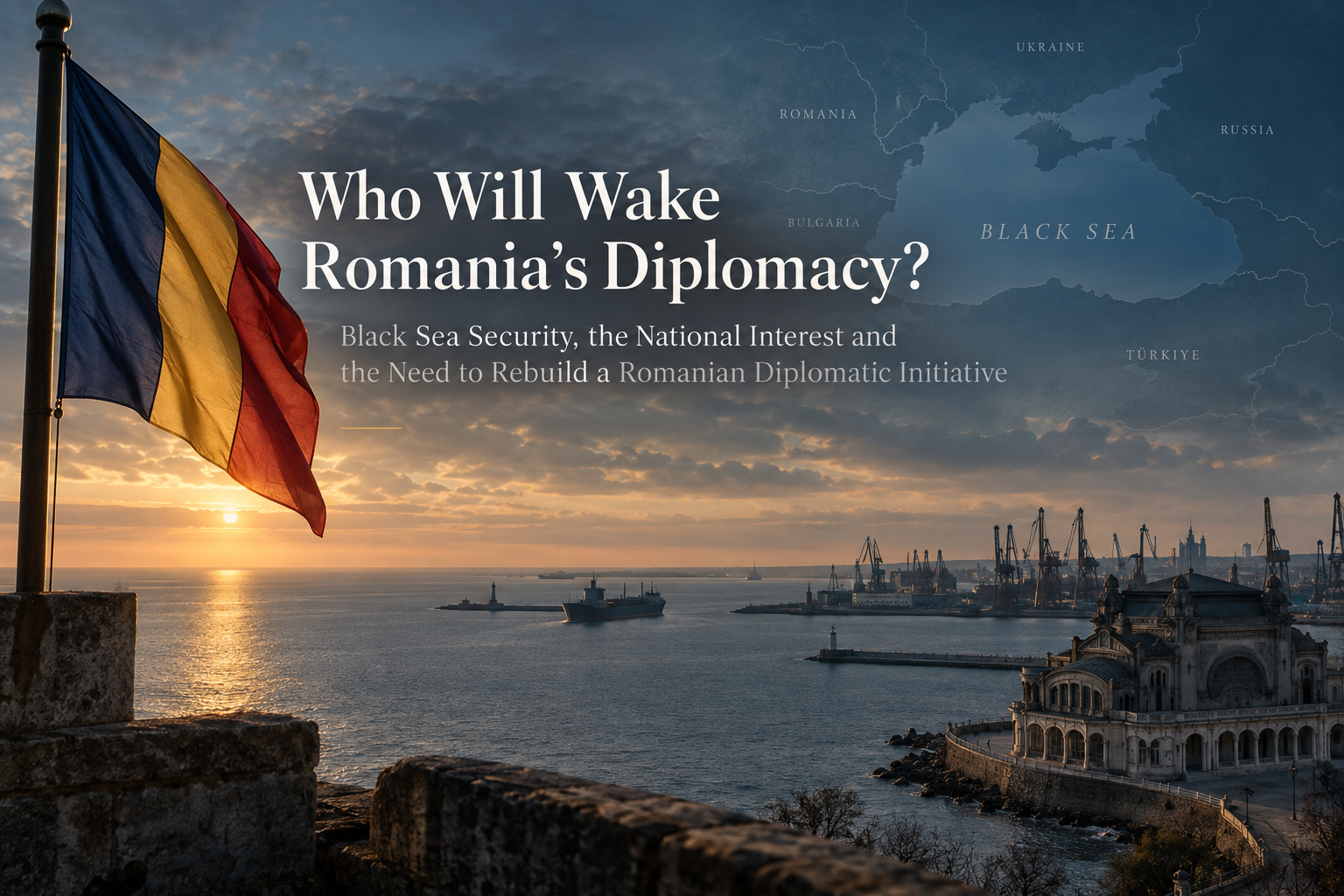
Romania's exposure to regional instability in its eastern neighbourhood demands a foreign policy that moves beyond reaction. In dialogue with the strategic insights of the Treatise on Maritime Security, this essay examines the institutional, human, and economic capacities required to transform geographic proximity into diplomatic influence.
Before any reflection on this subject, I would like to express my gratitude to Rear Admiral (Ret.) Dr. Romulus Hâldan for the Treatise on Maritime Security, written together with Admiral (Ret.) Dr. Gheorghe Marin and published by Editura Militară in Bucharest in 2022.
It is one of those works that should not be read exclusively through the narrow lens suggested by its title. Beyond its analysis of maritime security, the treatise compels the reader to return to fundamental questions concerning security, the national interest, the continuity of state policy, the relationship between alliances and national interests, cooperation, and the capacity of institutions to transform geographic reality into policy.
The authors themselves explain that they sought to proceed from “existing and lived reality”, rather than from a purely theoretical construction. This methodological choice appears particularly important at a time when strategic debate sometimes risks becoming detached from the very realities it is supposed to explain.
“Speak softly and carry a big stick—you will go far.” — Theodore Roosevelt, Minnesota State Fair, 2 September 1901
Theodore Roosevelt’s formula is usually remembered for its most spectacular element — the big stick. Far less attention is paid to the complete context in which it was expressed. Roosevelt warned against loud rhetoric, self-congratulation and, in particular, the facile denunciation of other peoples. Power had to exist, but its very existence was meant to make restraint in speech possible.
A nation that constantly raises its voice does not automatically become more powerful. Conversely, a nation that speaks calmly but lacks the means to protect its interests risks not being taken seriously. This relationship between strength and restraint is perhaps one of the most intuitive definitions of mature diplomacy.
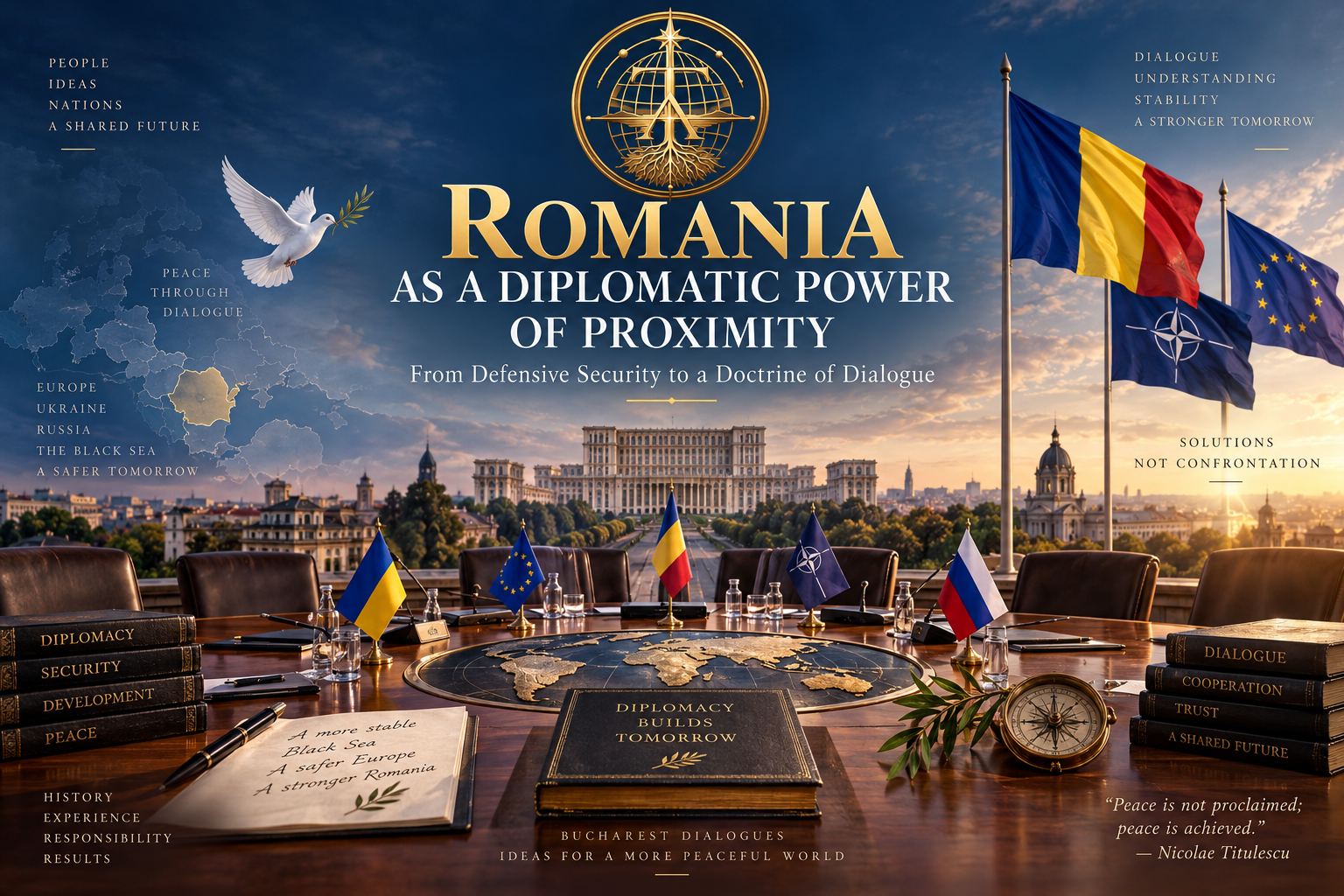
This article deliberately continues the reflection I began in “Romania as a Diplomatic Power of Proximity: From Defensive Security to a Doctrine of Dialogue.” There I argued that Romania’s geographic position, its membership of NATO and the European Union, and its direct exposure to the deterioration of the security environment in its eastern neighbourhood should not be regarded solely as vulnerabilities, but also as potential sources of diplomatic relevance.
The central argument was that Romania should not choose between security and diplomacy. On the contrary, it should transform the security provided by its alliances into a greater capacity for diplomatic initiative. The question today is more difficult. If we accept that Romania could become a diplomatic power of proximity, who will actually build that capacity? Who will transform a strategic idea into an institutional culture? Who will move from reaction to initiative, from communiqués to relationships, from positioning to influence?
The question is also a personal one. I am a graduate of the Romanian Diplomatic Institute, and my involvement with international economics, economic diplomacy, external relations and institutional cooperation extends over more than twenty years. During this period, I have had the opportunity to encounter not only the discourse of international relations, but also their less visible dimension: negotiations, economic interests, cultural sensitivities, relationships constructed over time and situations in which a correctly chosen sentence can keep open a channel that a spectacular declaration might close for years. From this perspective, I have become increasingly concerned that Romania may possess the institutions of diplomacy without always making full use of their strategic capacity.
The National Interest Must Be Defined Before It Can Be Defended
One of the most useful contributions of Gheorghe Marin and Romulus Hâldan’s Treatise on Maritime Security is its insistence on the relationship between security and the national interest. The work does not treat security as an abstraction, nor does it reduce it to its military dimension. Instead, it connects security with interests, institutions, economics, geography, international law and continuity. In its analysis of national interests, the authors also recover the realist perspective of Hans Morgenthau and the problem of classifying interests according to their importance and permanence.
This is precisely where one of the major difficulties of Romanian foreign policy becomes visible. We are very good at describing our affiliations. We say that we are members of NATO, members of the European Union, a Black Sea state, a strategic partner of the United States and supporters of the European path of the Republic of Moldova. All of these things are true and important. But membership is not yet a doctrine. It describes the framework within which a state acts. It does not automatically define what that state seeks to achieve.
The national interest begins where the state is capable of determining what it wishes to preserve regardless of the government in office, what it wishes to achieve over a ten- or twenty-year horizon, and what instruments it is prepared to develop in order to attain those objectives. The Treatise proceeds precisely in this direction when it stresses the continuity of vital interests and interests of the highest importance, and the fact that such interests should not change with every political transition.
For Romania, this means at the very least the security of its territory and population, the stability of the Republic of Moldova, freedom of navigation in the Black Sea and on the Danube, energy security, the functioning of logistics corridors, the development of the Port of Constanța, access for the Romanian economy to external markets, the protection of historic communities, and the construction of a sufficiently strong position within alliances for Romanian interests to be considered before decisions are taken, rather than merely after the fact.
From this follows an essential distinction: the foreign policy of an allied state should not become a delegated foreign policy. Alliances provide security, capabilities and solidarity. They do not relieve the state of the obligation to think. Morgenthau, cited in the Treatise, observed with considerable clarity that allied states rarely possess identical national interests; what can and must be constructed is complementarity between them. Such an argument does not weaken alliances. On the contrary, it makes them more mature. A partner that knows what it wants is more predictable and, ultimately, more valuable than one that continually defines its position according to what it assumes others expect from it.
Romania Is Not an Observer: It Is Directly Affected
In the previous article on diplomatic power of proximity, I concentrated primarily on potential. Today, something must be stated more clearly: Romania is directly affected by the security environment developing in its eastern neighbourhood. This is not a distant matter observed on television. Airspace incidents, alerts, objects identified in proximity to national territory, risks affecting navigation, infrastructure, energy and the civilian population demonstrate that Romania exists in an area of direct exposure.
This changes the nature of the discussion. For Romania, diplomacy is neither an exercise in prestige nor an intellectual activity reserved for the Ministry of Foreign Affairs. It is an instrument of national security. Precisely because Romania is directly affected, it cannot afford the luxury of a policy constructed exclusively from reactions. When the population is alerted, when military aircraft are scrambled, and when aerial objects reach or approach national territory, the state clearly requires a credible defensive capability. But it requires, to the same extent, every diplomatic, military, technical and political instrument capable of reducing the likelihood of repetition and escalation.
This is where Roosevelt becomes particularly relevant. A big stick without speaking softly is not a strategic doctrine. It is only half of one. Defensive capability must give diplomacy weight; diplomacy must give defensive capability a political purpose. This is precisely why Marin and Hâldan’s Treatise remains so relevant. The authors analyse maritime security not exclusively through its military component, but through a far broader architecture: the United Nations, the European Union, NATO, international law, infrastructure, economics, maritime interests, safety, cooperation and institutions.
In their own methodological approach, theory must emerge from reality. And present-day Romanian reality tells us very clearly that the Black Sea is not merely a strategic frontier. It is a commercial route, an energy space, an area of critical infrastructure, an access point for Romania towards external markets, a connection to the Danube, and one of the principal spaces in which economic interest and security interest overlap.
Diplomatic Power of Proximity Must Become an Institution
In the previous article, I used the expression “diplomatic power of proximity” to describe what Romania could become: not a great power in the classical sense and certainly not a self-appointed arbiter, but a state capable of transforming geographic proximity, regional knowledge and institutional membership into the ability to produce solutions, expertise and spaces for dialogue. But a doctrine without institutions remains an essay. For this idea to acquire substance, Romania must invest in people. There is no diplomacy without knowledge.
A country that wishes to matter in the Black Sea region must have diplomats who understand Russia, Ukraine, Türkiye, the Caucasus, the Balkans, the Republic of Moldova and Central Asia in depth; diplomats who speak the relevant languages, understand history, mentalities, institutions and economic networks, and who are capable of distinguishing between a message intended for public consumption and a genuine political signal. It should once again become normal for the state to cultivate expertise over twenty or thirty years, rather than merely fill posts for three or four.
The Romanian Diplomatic Institute should stand at the centre of this reconstruction. Diplomatic training should not be reduced to technical preparation for current administrative duties. It should be understood as the production of national strategic competence. Romania needs regional schools of expertise, permanent programmes for difficult and strategically relevant languages, serious research into the regions where it has interests, and a much closer relationship between diplomacy, economics, academia, defence and the private sector.
From my own experience of more than twenty years in international economics and cooperation, one of the most evident vulnerabilities is the artificial separation between diplomacy and economics. In the real world, major states do not separate these fields so rigidly. Ports, energy, finance, infrastructure, trade, agriculture, technology and access to markets are all instruments of foreign policy. Economic diplomacy is not an annex to diplomacy. It is one of its most concrete forms.
If Romania wishes to become relevant, it must know not only how to issue positions, but also how to build logistics corridors, how to open markets for Romanian companies, how to attract investment, how to use Constanța and the Danube within the regional economic architecture, and how to transform geographic advantage into negotiated advantage. That is diplomacy.
Less Diplomatic Theatre, More Diplomatic Results
Another problem is the temptation of reactive diplomacy. When international relations become tense, there are summonses, protests, public declarations and measures of reciprocity. Sometimes these are necessary. It would be a mistake to suggest that diplomacy should avoid firmness, or that diplomatic protest constitutes failure in itself. Failure begins when reaction becomes almost the only visible form of foreign policy.
Diplomacy has a public component, but its essence often operates away from the stage: technical discussions, secondary channels, confidential negotiations, personal contacts, the slow accumulation of trust and the transmission of messages clear enough to prevent dangerous misinterpretations. A good diplomat is not necessarily the person who produces the most memorable declaration. A good diplomat is the person who contributes to a result that is useful to his or her state.
Roosevelt deserves to be reread precisely from this perspective. He did not merely argue that power had to exist. He also argued that boasting and the facile denunciation of other peoples were unworthy of a serious nation. In contemporary terms, one might say that a mature state does not confuse the domestic audience with the negotiating table. Romania must possess the capacity to formulate firm positions when its interests are affected, while also retaining the intelligence to keep sufficient channels open for the day when dialogue again becomes necessary. Geography does not allow the luxury of indefinitely suspended relationships. Governments change. Circumstances change. Neighbourhood does not.
An Alliance Does Not Replace the National Interest; It Makes It Possible
Here another idea from the Treatise on Maritime Security is particularly useful. In examining responsibility for the interests of the state, the authors emphasise continuity and the institutions that must formulate, promote and defend interests considered vital or of the highest importance. This is precisely the perspective needed in diplomacy. Romania should not reinvent its strategic identity with every electoral cycle.
Membership of the European Union and NATO constitutes the fundamental framework of Romanian foreign policy. But the very stability of this framework should enable Romania to pursue more Romanian foreign policy, not less. Solidarity with allies does not require Romania to abandon creativity. On the contrary, states that influence alliances are those that bring proposals, expertise, formats and solutions. Influence is not obtained merely by approving common positions. It is obtained by participating in their formulation.
From this perspective, Romania could develop a distinctive diplomatic specialisation around several interconnected areas: the Black Sea, the Danube, the Republic of Moldova, connectivity between Central Europe and the Caucasus, regional energy, infrastructure security, and dialogue between European and Eurasian spaces. Such a specialisation would not distance Romania from its allies. It would make Romania more useful to them.
Who Will Awaken Romanian Diplomacy?
The title might suggest that we are waiting for the appearance of a providential individual. I do not believe this is the solution. Romania does not need to wait for “the next Titulescu”. It needs to rebuild the environment capable of producing people worthy of a great diplomatic tradition. It needs diplomats trained over time, institutions that preserve memory, researchers who genuinely understand the region, economists who understand geopolitics, military professionals who understand diplomacy, entrepreneurs who understand the public interest, and political leaders capable of distinguishing between the electoral interest of the moment and the permanent interest of the state.
Perhaps this is also the answer to the question posed in the title. Romanian diplomacy will not be “awakened” by a single individual. It will awaken when Romania decides once again that diplomacy is a strategic investment rather than an administrative function. When it understands that security means not only defence, but prevention. When the national interest is defined clearly enough to survive changes of government. When diplomatic initiative ceases to be regarded as a risk and begins to be understood as a form of power. When Bucharest ceases to be merely a place where the decisions of others are explained and becomes a place where ideas are formulated that others wish to discuss.
Romania is directly affected by what happens around it. That is precisely why it cannot afford to remain merely a spectator, a beneficiary of security, or an executor of collective decisions. Proximity creates vulnerability. But proximity also creates knowledge. And knowledge, when transformed into institutions, can become influence. The previous article concluded with the idea that Romania should build a table at which interlocutors can continue speaking without listening being confused with approval. That idea remains valid. But before inviting others to the table, we must rebuild our own diplomatic culture.
This may be the real challenge. Not to speak louder. Not to seek diplomatic prestige through declarations. Not to pretend that Romania can solve the major problems of the region alone. But to become so serious, so well prepared and so consistent that, when the moment comes in which diplomacy once again becomes indispensable, Romania is already prepared.
Roosevelt said: speak softly and carry the necessary strength. For twenty-first-century Romania, I would add one thing: Know your interest, build your strength, and never lose the capacity to speak.
Sources and Selected References
Marin, Gheorghe; Hâldan, Romulus. Treatise on Maritime Security. Editura Militară, Bucharest, 2022.
Roosevelt, Theodore. Address of Vice President Roosevelt, Minnesota State Fair, Minneapolis, 2 September 1901.
Morgenthau, Hans J. “Another ‘Great Debate’: The National Interest of the United States”, American Political Science Review, 46(4), 1952.
Afanasov, Tudor. “Romania as a Diplomatic Power of Proximity: From Defensive Security to a Doctrine of Dialogue”, afanasov.ro.
Tudor (Feodor) Afanasov — Bucharest, September 2026
- diplomatie
- politica externa
- securitate nationala
- marea neagra
- interes national
 Tudor Afanasov