The Great Powers’ Chessboard: The Old Woman’s Empty Chair and the Bridge Romania Must Build
From Shenzhen to the Kerch Bridge and Berlin: a reflection on diplomacy, power, peace, and the responsibility of a country that can no longer afford to remain a spectator.
“Pawns are the soul of chess.”
Three major powers meet in Shenzhen as Europe seeks its place at the negotiating table. An essay on Romania’s diplomatic responsibility, Black Sea security, industrial resilience, energy and peace.
I. The Three Took Their Seats at the Table
It is said that an ageing chess master would ask those who came to him for advice:
“What matters more in a game: making a powerful move, or understanding the game you are playing?”
The younger players almost always answered that the move itself determined victory.
The old master would smile.
“Not always. You may win a piece and lose the game. You may sacrifice a pawn and gain control of the entire board. But whoever no longer understands the position is already in danger, even while all his pieces remain.”
I recalled this lesson while observing the events of 19 November 2026.
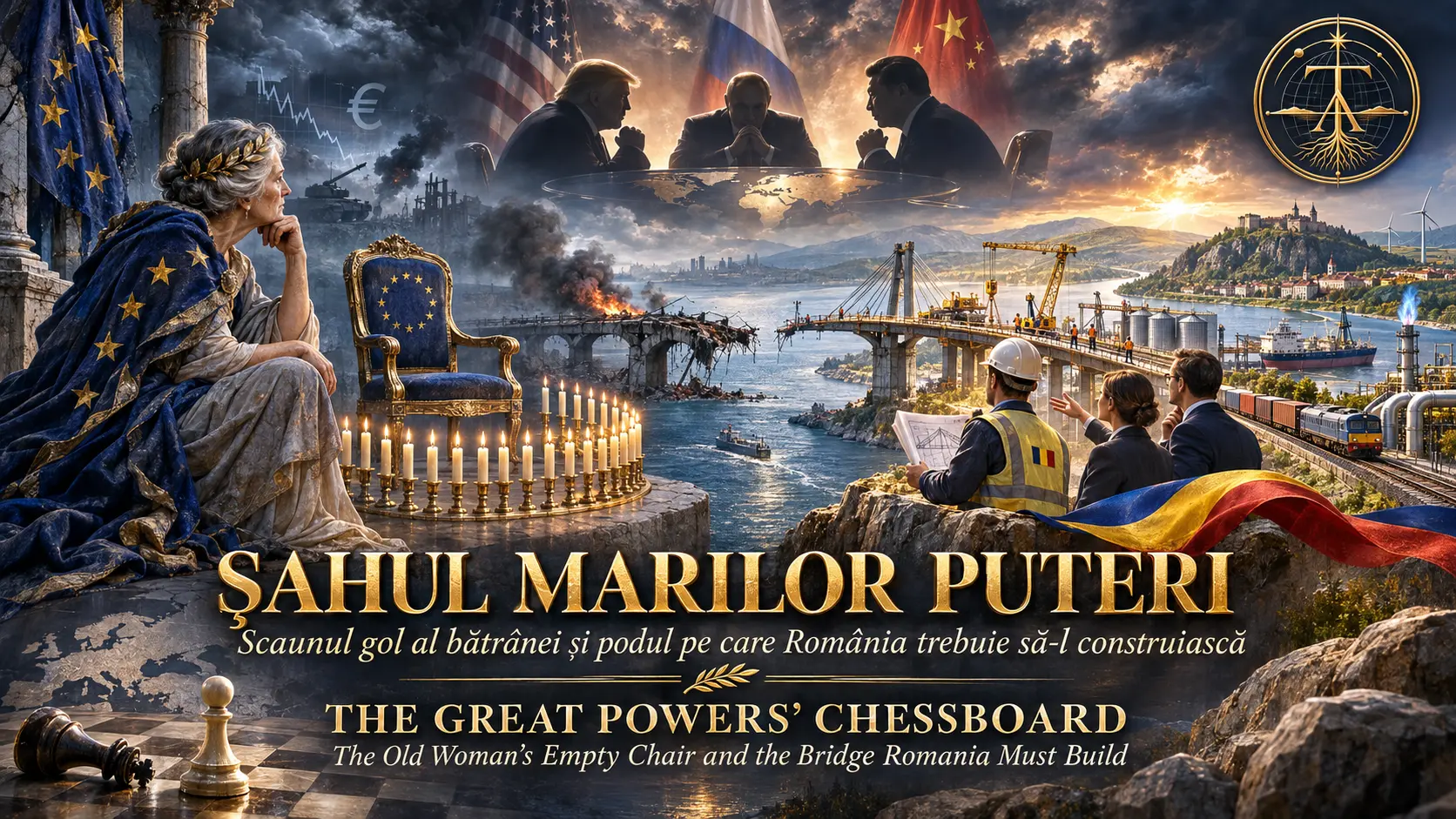
In Shenzhen, at a moment of international tension that our generation cannot regard as ordinary, three of the world’s most powerful leaders sat at the same table.
Donald Trump, Vladimir Putin and Xi Jinping.
Three leaders of nuclear-armed powers, representing different economies and political systems, with frequently conflicting interests and rivalries that did not disappear with a handshake.
They did not meet because the world had suddenly become harmonious.
They did not become allies, nor did they resolve every disagreement.
They did, however, something worth noticing in an age of polarisation: they agreed to speak directly.
Their joint declaration addressed strategic stability, dialogue on reducing nuclear risks, energy supplies and reform of international institutions.
It did not contain a concrete agreement to end the conflict that has devastated the lands east of the old continent for years.
It offered no timetable for peace.
It did not guarantee that today’s rivalries would become tomorrow’s cooperation.
Yet it sent an unmistakable signal: even powers that regard one another with suspicion recognise the need to keep channels of communication open.
In this respect, the meeting was a move.
We do not yet know whether it marked the beginning of a broader strategic combination or merely an exercise in positioning.
In chess, one move does not necessarily win the game.
But it may change how every other piece must move.
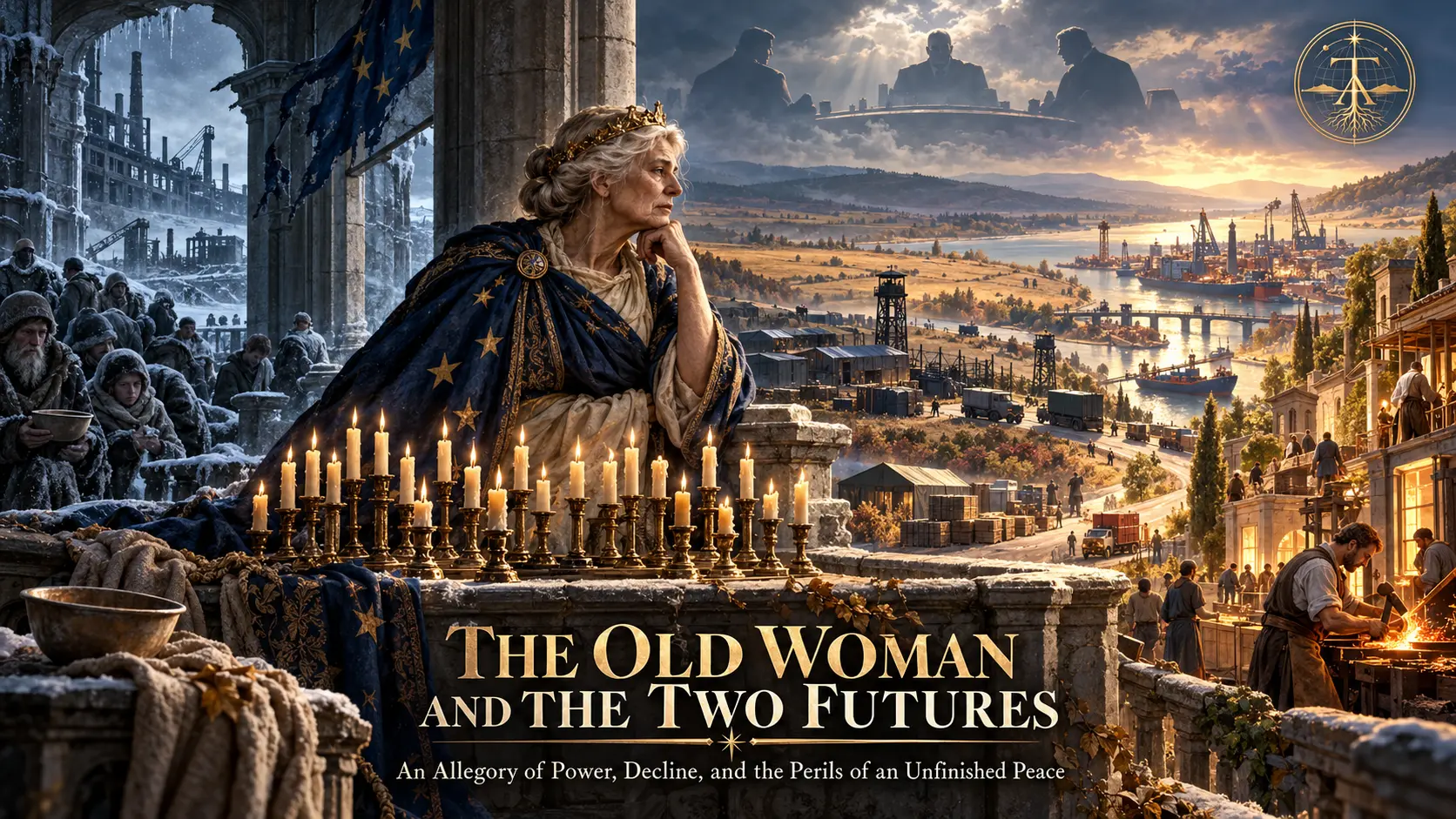
II. The Old Woman and Her Twenty-Seven Candlesticks
Some distance from that table stood an old woman.
Once, she had been among the world’s most powerful mistresses.
She possessed twenty-seven candlesticks, each illuminating a house with its own language, history and memory.
From her household had come great discoveries, machines, locomotives, ships, treaties and ideas that transformed civilisation.
After terrible tragedies, she had learned that people must find ways to live together.
And from that conviction she had built an impressive political structure.
Gradually, however, she began to believe that her international influence could be preserved through the mere existence of that structure.
She multiplied institutions.
She perfected regulations.
She drafted strategies for almost every problem in the world.
Yet sometimes she forgot that strategy is not the document describing the future. Strategy is the capacity to influence it.
When news of the meeting of the three reached her palace, she summoned her advisers.
“Where is our chair?”
“We were not invited to this table, Madam.”
“But they are discussing matters that affect us directly.”
“We shall demand to be consulted.”
“And what shall we do if the three continue talking among themselves?”
The advisers began speaking of joint declarations, coordinated positions and institutional formats.
The old woman listened.
Not all their arguments were mistaken. No one could dispute the legitimate interest of her twenty-seven houses in participating in decisions affecting their security.
But a more difficult question remained.
Why had such a wealthy household come to regard admission to somebody else’s table as proof of its own importance?
And why could it no longer convene, with sufficient authority, a table of its own to which others would wish to come?
The old woman’s absence from a trilateral summit did not mean she had been excluded from every international negotiation. That same day, consultations were taking place in Berlin, including discussions with American representatives.
Nevertheless, the image was striking.
Three major powers were speaking directly.
The old woman was trying to consolidate her place in a process she did not fully control.
History seemed to be asking her once again the question she preferred not to hear:
Is it enough to possess the right to participate, or must one also possess the power to influence the outcome?
III. Two Rooms, Two Diplomatic Languages, One Problem
On the same day that the three met in the East, leaders gathered in a great western city to discuss the future of the land at war.
The two gatherings did not pursue identical objectives.
That was precisely why their contrast mattered.
In Shenzhen, the public language emphasised the shared responsibilities of major powers, strategic stability and dialogue.
In Berlin, the emphasis fell on security guarantees, support for the country under attack, the conditions of a durable peace and European participation in the negotiating process.
German Chancellor Friedrich Merz rejected the idea of another Yalta-style arrangement in which major powers would decide the future of others without their participation.
Kaja Kallas emphasised a ceasefire, sanctions and the need for any agreement to prevent a renewal of hostilities.
Ursula von der Leyen supported continued financial and military assistance and sustained pressure on Moscow.
These positions do not, in themselves, demonstrate a desire to prolong the conflict. Their supporters argue that peace without credible guarantees could prepare the ground for another confrontation.
That is a security argument deserving serious consideration.
Yet diplomacy must confront another legitimate question:
How can military support, economic pressure and security guarantees be transformed into an actual negotiating mechanism, with stages, verifiable concessions and a politically achievable outcome?
It is not enough to declare that peace is desirable.
There must also be a credible road towards it.
Carl von Clausewitz described war as a continuation of politics by other means.
That observation also imposes another responsibility: political leadership cannot abandon the search for the moment and conditions under which military instruments can give way to negotiation.
Pressure may create incentives for compromise.
Deterrence may prevent further attacks.
But neither can indefinitely replace a realistic diplomatic objective.
The principal difficulty is not the existence of two different approaches.
It is the possibility that they will proceed in parallel without converging quickly enough into a common architecture for peace.
IV. The Bridge That Was Never Merely a Bridge
At the centre of this geopolitical game stood a bridge.
A long bridge across a strait, connecting a mainland shore to a peninsula whose sovereignty and control had become among the most contentious questions of the age.
For its builders and the authorities in Moscow, the bridge carried considerable political and symbolic significance.
For their adversaries, it was also strategic infrastructure used for supplies, including military logistics.
For ordinary people, it remained a road.
In chess, a piece derives its value not only from the square it occupies but also from the lines it controls.
Likewise, a bridge is more than concrete, steel and traffic.
It may represent territorial continuity, prestige, logistics, military access and political authority.
That is why an attack on such an objective cannot be assessed solely by the scale of material damage.
In the days preceding the meeting of the three, repeated attacks were carried out against the Kerch Bridge, including another strike during the night of 18–19 November.
The timing coincided with the preparations and proceedings of one of the year’s most significant diplomatic gatherings.
Vladimir Putin subsequently stated that, following those attacks, Moscow would no longer consider negotiating the limited moratoriums previously discussed concerning energy infrastructure and activities in the Black Sea.
He also promised a painful response.
According to his statements, this was the immediate political consequence of the episode.
We cannot demonstrate that the attack was intended to sabotage the trilateral meeting. Nor can we conclude that a ceasefire agreement would certainly have emerged had the attacks not occurred.
Moreover, the authorities of the country at war argue that strikes on the bridge have a military justification because of its logistical role, while also pointing to repeated attacks against their own infrastructure.
One thing, however, was evident: the risk of a severe reaction was foreseeable.
This brings us to a principle understood by every great chess master.
It is not enough to calculate what a move might gain.
One must calculate the opponent’s response.
Anticipate what comes next.
And, above all, ask whether the result brings one closer to or further away from the ultimate objective.
In certain circumstances, damaging a bridge may mean far more than interrupting a transport connection.
It may also close a window for dialogue.
And in a world where major powers possess unprecedented means of destruction, every closed window should concern us.
V. The Mistake of Confusing a Move with a Strategy
Old chess literature preserves a piece of advice associated with the tradition of Pedro Damiano:
“When you find a good move, look for a better one.”
It is a simple rule.
Yet international politics often seems to forget it.
Another sanction may appear to be a good move.
Another financial allocation may seem necessary.
A military demonstration may appear to signal strength.
A severe declaration may win approval at home.
But what is the next move?
And the one after that?
How long can pressure be sustained?
Under what conditions can an adversary accept a settlement without interpreting it as a demand for unconditional capitulation?
What guarantees can prevent a concession from becoming an invitation to renewed confrontation?
And who pays the price if these questions remain unanswered?
This is the distinction between a sequence of reactions and a strategy.
The three leaders in Shenzhen did not demonstrate that they could resolve these contradictions. Their declaration remained limited and left substantial ambiguities.
Yet by meeting, they demonstrated that rivals can find dialogue useful even when they are not ready to make peace.
The old woman, meanwhile, must ask herself whether her mobilisation of resources is matched by sufficient diplomatic initiative.
Not in order to abandon the principles of international law.
Not to accept that a people should become a bargaining chip.
Nor to relinquish her own security.
But to avoid a situation in which these objectives are defended almost exclusively through instruments that increase the cost of confrontation.
Peace cannot be achieved through declarations alone. But neither can it be built if diplomacy is treated as an activity permitted only after every other instrument has been exhausted.
VI. The Pawn on the Black Sea
At the edge of the chessboard stood a piece that hurried spectators did not consider decisive.
It was not a queen.
It did not possess the power of a rook or the mobility of a major piece.
But it occupied an important position.
Before it lay routes towards the East.
Behind it stood an entire political and security structure.
Beside it flowed a great river connecting the continent’s markets with the sea.
And beyond the coastline lay energy resources capable of changing regional economic relationships.
That piece was Romania.
François-André Danican Philidor earned his place in chess history through his understanding of the role of pawns in the structure of a position.
A pawn may seem insignificant when viewed in isolation.
Yet it may control a decisive square, support an entire strategic formation and, upon reaching the far end of the board, transform its value.
In international politics, states do not possess equal power.
But neither geography, economic capacity nor diplomatic influence has a fixed value for all time.
These advantages can be developed or squandered.
Romania cannot, by itself, impose the terms of a global agreement upon the great powers.
It is neither a nuclear power nor a neutral actor standing outside international alliances.
It belongs to the European Union and NATO, and those memberships are fundamental components of its security.
But alliance membership must not be confused with the abandonment of independent strategic thought.
Quite the contrary.
A respected member of an alliance should be able to contribute expertise, initiative and solutions.
It should bring value to negotiations.
Formulate proposals.
Anticipate risks.
Identify opportunities where others see only obligations.
Romania possesses diplomatic experience, institutions, professionals and international relationships that could be put to more effective use.
Its historical communities also embody experience of coexistence among different languages, traditions, religions and identities.
That experience cannot automatically resolve conflicts among major powers, but it can nourish a diplomatic culture of dialogue.
Geography, meanwhile, gives Romania a responsibility it cannot ignore.
It stands beside one of the continent’s most sensitive regions.
Decisions negotiated in distant capitals may become, here, Black Sea security challenges, higher energy costs, logistical pressures, trade disruptions or opportunities for reconstruction.
The question, therefore, is not whether Romania is large enough to matter.
The question is whether it knows how to turn its advantages into real influence.
VII. What Does It Mean to Fear the Year 2028?
On that same day in Bucharest, President Nicușor Dan made a statement that deserves serious reflection:
“I am afraid of 2028.”
He spoke of the time Romanian society had lost in minor disputes, of education, digitalisation, revenue collection and the resources consumed by security challenges.
He subsequently clarified that his concern also related to the possibility of a particular outcome in the parliamentary elections scheduled for that year.
His words should not be taken out of context or artificially transformed into a prediction of economic collapse.
Nevertheless, they invite a much more important question:
If the near future causes concern at the highest level of the state, what concrete plan exists to strengthen Romania’s economy, institutions and capacity to withstand new crises?
The economic figures do not justify complacency.
The European Commission’s forecast of 17 November projected a 0.3% contraction of the Romanian economy in 2026, average inflation of 7.9% and a general government deficit equivalent to 6% of GDP.
Public debt was projected to reach approximately 64% of GDP by 2028.
These are forecasts, not unavoidable destinies.
Yet they describe an economy with limited fiscal room, facing pressure to consolidate public finances while maintaining the investment needed for future growth.
In such circumstances, every financial commitment must be examined in terms of strategic benefit and sustainability.
Security support cannot simply be abandoned.
But neither can the economy that finances it be neglected.
We cannot speak of strong defence while resignedly accepting the erosion of our industrial base.
We cannot demand technological modernisation without ensuring competitively priced energy.
We cannot claim strategic autonomy without investment, specialists and productive capacity.
And prosperity cannot be maintained indefinitely through borrowing and redistribution of increasingly constrained resources.
A country that loses its capacity to produce gradually loses its freedom to choose.
VIII. Steel, Energy and the Real Foundations of Security
In another part of the country, on the banks of the Danube, stands a symbol of an era in which Romania built major industrial capabilities.
The Galați steelworks.
Such a facility is more than buildings, furnaces and machinery.
It represents technical expertise, supply chains, employment, infrastructure and an economy’s capacity to manufacture strategically important goods.
In November 2026, Romanian authorities intervened to support the plant’s restructuring and protect approximately 2,400 active employees.
That is a measure of the seriousness of the situation.
But the problem extends beyond a single company.
It concerns the future of metallurgy, energy-intensive manufacturing and Romania’s ability to participate in major infrastructure and reconstruction projects.
Not every enterprise can be saved with public funds.
Nor can every old industrial capacity become competitive without restructuring, technology and capital.
Nevertheless, a responsible state must know which sectors are strategic, which assets merit preservation and what conditions must be imposed so that public investment does not become permanent subsidisation of losses.
At the same time, the Black Sea offers Romania a historic opportunity.
The Neptun Deep project is expected to deliver its first natural gas into the national transmission system in the first half of 2027.
This prospect could support a new stage of industrial development.
Yet extracted gas should not be viewed exclusively as a commodity for sale.
It could also support domestic manufacturing, the chemical industry, fertiliser production, electricity generation and the development of industrial value chains.
Romania must ask whether it wishes merely to serve as a corridor for resources and goods belonging to others, or also as a place where those resources are transformed into competitive products.
The Port of Constanța, the Danube, energy infrastructure and connections with neighbouring markets could together form a regional economic platform of considerable importance.
But only if managed as components of a coherent strategy.
A port without industry is primarily a transit point.
An energy resource without productive investment generates revenue but does not guarantee a strong economy.
And an advantageous geographical position, without diplomacy and infrastructure, remains merely a fact on a map.
IX. The Bridges We Have Yet to Build
Let us return to the Kerch Bridge.
The world has once again seen how quickly strategic infrastructure can become the focus of escalation.
But there is another kind of bridge.
One that cannot be destroyed by a missile because it is not made of steel and concrete.
It is constructed from trust, mutually recognised interests, communication and verifiable compromises.
That is the bridge of diplomacy.
Romania has the opportunity to contribute to building such a bridge.
Not by unilaterally proclaiming itself a universal mediator.
A mediator must be accepted by the parties involved and possess a credible mandate.
But Romania can propose and host technical consultations, economic meetings and discussions on regional security, in accordance with its European and Euro-Atlantic commitments.
It can help formulate mechanisms to protect navigation and energy infrastructure in the Black Sea.
It can support connectivity, reconstruction and economic cooperation projects for the period following a cessation of hostilities.
It can contribute to measures addressing arms control, illicit trafficking and the economic reintegration of regions affected by conflict.
It can build an agenda in which security, energy, transport and reconstruction are treated as parts of the same strategic challenge.
Above all, it can insist that the interests of Black Sea states be represented in any security architecture that will shape their future.
Romania does not need to choose between loyalty to its partners and independent thought.
It can do both.
A mature foreign policy does not mean demonstrative opposition to allies.
It means having the capacity to explain why particular solutions are necessary, to anticipate their consequences and to propose better alternatives when regional realities require them.
That is the difference between implementing a position and contributing to its formulation.
X. What Shall We Do on the Day After?
There is one moment about which far too little is still said.
The day after.
The day when the weapons fall silent, if and when a settlement is reached.
What will happen to the devastated regions?
Who will finance the reconstruction of infrastructure?
How will borders be protected?
How will people who have spent years in an economy adapted to conflict be reintegrated?
Who will monitor weapons stockpiles, military technologies and potential clandestine routes?
How will commercial circulation, insurance, maritime transport and energy connections be restored?
And what role will neighbouring states play?
The history of the former federated territories in the south of the continent has shown that the end of fighting does not automatically eliminate illicit economies, illegal arms or social tensions.
This does not mean that such developments are inevitable in the eastern country.
On the contrary, well-managed reconstruction can transform military experience, technological capacity and international assistance into resources for stability.
But preparation must begin before the final day of conflict.
For Romania, the question is essential.
Do we wish merely to be a territory crossed by convoys and materials destined for reconstruction?
Or do we intend to participate directly, through our industry, energy capabilities, construction, engineering and transport companies, and our specialists?
There are compelling reasons to prepare projects and consortia now, capable of contributing to regional reconstruction.
Bridges.
Railways.
Electricity networks.
Ports.
Factories.
Warehouses.
Water supply systems.
Some of these projects will require exactly the industrial expertise that we risk losing today.
That is why the debate about peace must also become a debate about the future of the Romanian economy.
We cannot participate meaningfully in rebuilding a region if, by that time, we have lost our own capacity to build.
XI. Romania’s Chair Must Not Remain Empty
The old chess master in our story looked once more at the board.
Before him stood the major pieces.
Kings.
Rooks.
Knights.
And a pawn positioned near the edge.
An apprentice asked:
“Can a pawn change the outcome of a game?”
“Yes,” replied the master. “But only if the player understands the value of its position and knows where he intends to take it.”
“And if he moves it without thinking?”
“Then he may lose not only the pawn, but the entire structure it was meant to defend.”
Romania’s position should be considered in the same spirit.
We are not called upon to determine the global order alone.
But we have a duty to determine our own priorities.
We must support security without forgetting that its purpose is to protect life and prosperity.
We must cultivate relations with our partners without renouncing our own expertise and interests.
We must participate in collective defence mechanisms while using every legitimate diplomatic opportunity to reduce tensions.
We must have the courage to speak of peace without confusing dialogue with weakness.
And we must understand that diplomacy is not a performance staged for television cameras.
Diplomacy means relationships cultivated over years, negotiations conducted with patience, the ability to listen even to positions with which we disagree, and the skill to transform an initiative into a result.
Real international influence is not measured solely by the number of meetings one attends.
It is measured by what one succeeds in changing through participation.
Romania needs a foreign policy that addresses security, economic development and diplomacy simultaneously.
It needs industry capable of supporting its freedom of decision.
It needs leaders who understand that responsibility to future generations cannot be reduced to managing today’s crises.
And it needs a clear objective: to be recognised as a partner offering solutions, rather than merely a state expressing agreement or concern.
XII. The Move History Is Still Waiting For
The meeting of the three leaders may, in years to come, be remembered as nothing more than a photograph.
A demonstration of prestige.
Another episode in the long competition among the world’s major powers.
Or it may become the first move in a broader diplomatic process.
Today, we do not know.
What we do know is that the joint declaration did not resolve the conflict in the East and that, on the same day, strikes against the Kerch Bridge and Moscow’s response demonstrated just how fragile the prospects for de-escalation remain.
We know that the old woman with twenty-seven candlesticks still possesses considerable resources, but continues to seek the most effective way to exercise influence in the new negotiations.
We know that Romania lies in a region where these decisions will have direct consequences.
And we know that our economy cannot afford an indefinite period of hesitation.
Faced with these realities, I believe the fundamental question should not be whether we stand on the side of one or another of the world’s great leaders.
Romania already has clear international commitments.
The question is what contribution of our own we can make to peace, stability and prosperity within those commitments.
What proposals do we have?
What platforms can we make available?
What economic projects are we preparing?
Which industrial capabilities do we intend to preserve?
Which risks are we prepared to prevent before they become crises?
In the world of chess, great masters are not recognised because they move pieces faster than everyone else.
They are recognised because they see further ahead.
And in diplomacy, true mastery lies not in making the harshest statement, but in finding the solution that protects legitimate interests and makes a lasting outcome possible.
Perhaps history will not remember today’s meeting as the beginning of a new order.
Perhaps it will not remember the bridge struck on the same day as a decisive moment.
But history will certainly judge how the leaders of states close to these events understood their responsibility.
Romania may remain a piece reacting to the moves of others.
Or, through consistency, competence and initiative, it may build a position from which it matters.
It is not enough to demand a chair at the table of the future. We must have something to bring to that table.
And if the world once again seems to be approaching a dangerous precipice, perhaps Romania’s most important contribution is not to learn to raise its voice even louder.
It is to learn to build bridges where others see only reasons to destroy them.
A bridge may be struck in a single night.
But the trust required to rebuild it may take generations.
And perhaps this is precisely the move that history is waiting for us to make.
Let us not be the country that watches the board and waits for others to decide. Let us be the country that understands the game and helps shape its course.
Tudor Afanasov
19 November 2026
Sources and Selected Bibliography
- 1.White House — U.S.–Russia–China Heads of State Declaration toward Peace, 19 November 2026
- 2.German Federal Government — Coalition of the Willing meeting in Berlin, 19 November 2026
- 3.Reuters — Putin rules out Black Sea, energy truce after Crimea bridge strike, 19 November 2026
- 4.European Commission — Economic Forecast for Romania, 17 November 2026
- 5.European Commission — proposal for up to EUR 45 billion in additional financial support for Ukraine in 2027
- 6.AGERPRES — President Nicușor Dan: “I am afraid of 2028”, 19 November 2026
- 7.AGERPRES — President Nicușor Dan clarifies he was referring to elections, 19 November 2026
- 8.OMV Petrom — Neptun Deep, first gas production expected in the first half of 2027
- 9.Romanian Government / AGERPRES — the situation of Liberty Galați, November 2026
- 10.French Chess Federation — history of François-André Danican Philidor
- 11.Edward Winter, Chess History — origin of the maxim on looking for a better move (tradition of Pedro Damiano)
- Geopolitical Analysis & Strategic Reflection
Tudor Afanasov