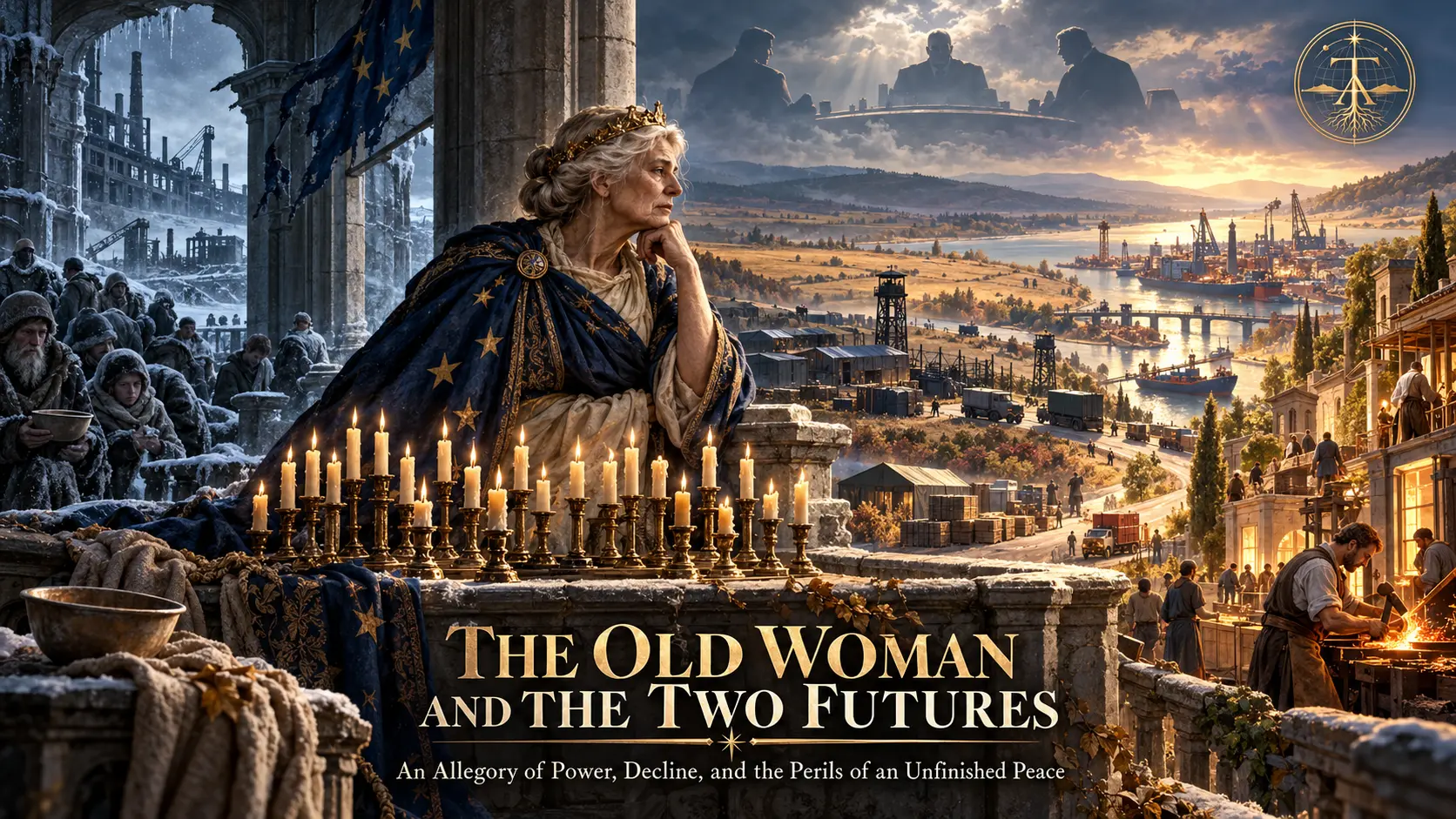
The Old Woman and the Two Futures
An Allegory of Power, Decline, and the Perils of an Unfinished Peace

“There is nothing new under the sun.”
An old woman with twenty-seven houses watches the world change around her. A geopolitical allegory about industry, dependency, diplomacy, and the uncertain aftermath of conflict.
I. The Old Woman Who Once Ruled the World
They say that in a land blessed with rivers, mountains, and fertile plains, there lived an old woman who had once been among the most respected rulers of the known world.
She had twenty-seven great houses, each with its own customs, language, and history. Some were wealthy, others poorer, yet all had gathered beneath one roof, convinced that together they would be stronger.
The old woman had inherited rich farmland, celebrated crafts, libraries, schools, ports, and factories. Her smiths built machines admired by merchants from distant lands. Her ships crossed the seas, and her people believed that each new generation would live better than the one before.
Great ideas about liberty, dignity, science, and justice had once travelled outward from her house.
But the years passed.
The children of those who had built her prosperity began to believe that wealth was a natural condition of the world, rather than the result of labour that had to be renewed with every generation.
Over time, the old woman surrounded herself with advisers.
They were not uneducated men and women. On the contrary, they knew laws, regulations, and theories of how the world ought to be organised.
Yet many had not seen a field worked before sunrise, a steel furnace, or a factory in which people's wages depended on the following day's orders for a very long time.
One morning, the advisers brought her a message.
“Madam, we must change the world. We must save the earth.”
The old woman agreed.
The earth did need protecting. The air should be clean, the rivers safeguarded, and the forests tended.
But as time passed, some advisers began to mistake care for nature for suspicion of nearly every form of human endeavour.
They resolved to transform, within a very short time, the ways in which people heated their homes, worked, cultivated their land, and travelled.
They called for old hearths to be extinguished before new ones were ready to take their place.
They laid new obligations upon workshops, without always asking whether the same goods would then arrive from far away, made under less demanding rules.
They asked farmers to achieve more with increasingly expensive means.
And they began to measure success less by what the household could produce than by how many decrees it could pass.
One day, an elderly farmer stood before them.
“If you wish to preserve fertile soil, why burden the very people who cultivate it?”
The advisers answered by showing him a long scroll of parchment.
The man looked at it and said:
“I asked you about bread, and you answer me with ink.”
No one listened.
And so the old woman made her first truly dangerous mistake: she began to believe that something became possible the moment it was written into law.
II. The Merchant Who Rode a Bicycle
Far away, beyond mountains and seas, there lived a merchant from the East.
When the old woman was young, he possessed little wealth.
Endless streams of bicycles moved along the roads of his cities, while the old woman admired her automobiles, locomotives, and great factories.
The merchant watched carefully.
He did not spend his days complaining that others were richer.
He learned.
He purchased machinery, built factories, sent young people to study, and began producing goods that he had once been forced to import from across the seas.
His path was neither free of mistakes nor of injustices.
But he pursued his interests patiently: turning knowledge into industry, and industry into power.
Generations passed.
One day, the old woman stepped outside the palace gate.
Modern automobiles from the eastern merchant's workshops were travelling along the great road.
They were becoming more numerous and better equipped, reaching markets in which they would once have struggled even to compete.
Beyond the gate, a young man from her own household rode peacefully past on a bicycle.
There was nothing wrong with that. A bicycle remained a useful and healthy means of transport.
Yet an unsettling thought came over the old woman.
Once, people in the East had often ridden bicycles because they could afford little else, while her own people built the automobiles the world desired.
Now the eastern merchant was building an ever greater share of the vehicles of tomorrow, while she urged her own people to consume less.
The real contrast was not between bicycle and automobile.
It was between two ways of imagining the future.
One had learned to produce ever more.
The other was beginning to believe that progress could be achieved mainly by restraining consumption.
The old woman had failed to grasp that a civilisation could learn to use resources more wisely without abandoning the ambition to manufacture, invent, and prosper.
And that when you lose your workshops, you do not necessarily become cleaner.
You may simply become more dependent.
III. The Winter When Wealth Could No Longer Keep Out the Cold
Then difficult times came.
Energy became more expensive, some factories reduced production, and people looked with growing anxiety at the bills arriving each month.
The old woman still possessed great riches.
But she had discovered that wealth did not always mean independence.
She bought energy from afar, technology from the East, and part of the protection of her household from across the ocean.
Once, she had maintained numerous trading ties with her neighbours.
Some had been broken, others abandoned, and still others had become so uncertain that she no longer dared rely on them.
New dependencies had taken the place of old ones.
Her advisers called it diversification.
The merchants spoke to her of market prices.
Ordinary people asked how much more it would cost them to live.
On a cold evening, a woman from a distant village sent the old woman a letter:
“We have done everything we were asked. We saved, replaced what was old, and paid the new charges. But why, in a land so wealthy, must we wonder how much warmth we can afford?”
The old woman read the letter again and again.
She summoned her advisers.
“How can our household be so wealthy, yet some of its people cannot keep their homes adequately warm?”
“The situation is complex,” they replied.
“But why are workshops closing?”
“Because we must adapt.”
“And where will the things we no longer produce be made?”
“In other lands.”
“And who will sell them to us?”
The advisers fell silent.
The old woman was beginning to understand that power is measured not only by accumulated wealth, but also by the ability to keep producing what one needs.
A household that can no longer control the cost of its energy or preserve its crafts is like a magnificent castle whose keys are kept, one by one, in the pockets of its neighbours.
IV. The Great Protector and the Price of Friendship
Across the endless waters lived a mighty ruler.
For many generations he had been the old woman's protector.
He had helped her, traded with her, and seen her through dangerous times.
Their friendship had a long history.
But the ruler of the seas was also a skilful merchant.
He knew how to sell energy, protect his own industries, and demand favourable terms for his household.
One day, the old woman asked for his help once again.
He received her courteously.
He spoke of solidarity, values, and friendship.
Then he opened the book of negotiations.
The old woman discovered that every bargain came at a price.
There was nothing unusual in that.
Great bargains had been struck this way since ancient times.
Yet she had grown so accustomed to the language of friendship that she had almost forgotten that her protector had interests of his own.
When she returned home, an adviser told her:
“Madam, we have preserved the friendship.”
“But have we strengthened our power?”
“We have avoided a quarrel.”
“But will we be able to bargain more effectively next time?”
The adviser gave no answer.
Then the old woman remembered an ancient saying:
Friendship among the great may be sincere, but it does not abolish each party's calculations.
V. The Three Rulers and the Table Without a Fourth Chair
In those days, the world had three great rulers.
One held sway over the seas, finance, and the great routes of commerce.
Another commanded vast expanses of land, natural riches, and military power that no one could afford to disregard.
The third had raised so many workshops and ports that his merchandise could be found almost everywhere.
The three were not friends.
They had rivalries, disagreements, and interests that frequently collided.
But each knew that none could ignore the power of the others forever.
And so a rumour spread that a day might come when the three would sit at the same table.
No one knew whether the meeting would take place.
Still less whether it would produce an agreement.
Yet the possibility alone troubled those who had grown used to believing that no great decision could be made without them.
When the old woman heard the news, she summoned her advisers.
“Where is my chair?”
“Madam, the table has not yet been set.”
“But what if it is?”
“We shall ask to be consulted.”
“And if the three wish to speak without me?”
“We shall express our profound concern.”
For the first time, the old woman felt how cold such an expression could be.
She had uttered it many times herself.
But she had never considered how little the concern of a household might change when that household no longer knew how to defend its own interests.
That evening, an elderly diplomat arrived at the palace.
“Tell me,” she asked, “why does the world no longer listen to me as it once did?”
The diplomat replied:
“Because you have mistaken the riches of the past for the power of the present.”
“But I have laws!”
“And others have interests.”
“I have institutions!”
“And others have the means to defend or negotiate their interests.”
“I have friends!”
“But friends are not obliged to do your thinking for you.”
“Then what must I do?”
“Remember that a seat at the table of the powerful is not an inheritance. It must be sustained by economic capacity, political will, diplomacy, and bargaining power.”
The old woman looked around her.
The palace was still beautiful.
But for the first time it seemed too large for the power she retained.
VI. The Six Cities of the South and the Curse of Wandering Weapons
One morning, the diplomat returned with an elderly chronicler.
He carried a thick, leather-bound book.
“Before you decide what to do about the land on your eastern frontier,” the chronicler told her, “you ought to remember what happened long ago in the South.”
He opened the book.
There had once been a great household made up of six cities.
Their inhabitants had spoken related languages and shared roads, markets, and a common history.
But the time came when the bonds between them were broken.
Fire, hatred, and suffering swept across their hills and valleys.
At last, the thunder of the guns fell silent.
People hoped that quiet would bring back the life they had known.
Yet not every weapon had vanished from the old arsenals.
Along the roads once used for military supplies, merchants without names began to travel.
Some sold weapons.
Others carried forbidden goods.
Others transported white poisons and powders that promised oblivion but brought addiction and death.
And where jobs were scarce and institutions remained weak, the networks of smuggling found people they could recruit.
Not everyone who returned from the fighting had become a wicked person.
On the contrary, most longed for peace, family, and honest work.
But a few criminal hands, aided by unguarded weapons and hidden trading routes, were enough to spread danger far beyond the old borders.
The years passed.
The southern realms changed.
Cities and institutions were rebuilt, and many people pieced their lives together again.
Yet some old weapons and smuggling networks continued to trouble distant lands.
The old woman closed the book.
“And why are you telling me all this?”
The chronicler replied:
“Because when a great fire is extinguished, people rejoice that the flames have disappeared. Few ask where the burning embers have gone.”
VII. The Land of Golden Grain and Iron Granaries
East of the old woman's house stretched a vast land.
It had fertile plains, rivers, ports, and ancient trade routes.
Once, its granaries had been filled with grain.
But after years of calamity, countless military depots had appeared beside the storehouses of bread.
Its craftsmen had learned to build machines that could see far into the distance, iron birds without pilots, and weapons capable of reaching beyond the horizon.
Its people knew things that many armies in peaceful lands understood only from books.
But this knowledge had been purchased with terrible suffering.
Destroyed homes.
Scattered families.
Children raised without knowing tranquillity.
Men and women longing to return to their former lives, yet uncertain whether those lives could ever be recovered.
One day, the chronicler painted two pictures before the old woman.
In the first, the fields blossomed again.
Weapons were safeguarded by strong institutions. Those who had fought returned to their families, received care, learned trades, and rebuilt their communities.
Military workshops began making things that served peace.
Roads were repaired.
Children went to school.
And the borderland became a powerful but stable neighbour.
“This,” said the chronicler, “is the future you must try to help build.”
In the second picture, the guns had fallen silent, but quiet had brought no prosperity.
The treasury was almost empty.
Great promises of reconstruction were slow to become roads, homes, and jobs.
People had returned, but not all had a home to return to.
Those trained in the use of arms needed a path back into ordinary life.
In some places, clandestine networks tried to buy what the authorities could not adequately oversee.
A missing weapon.
A military component.
A piece of information.
A shipment.
Alongside honest commerce struggling to re-emerge, there could arise those who sold forbidden goods, poisonous substances, and false promises to people driven to desperation.
“This,” said the chronicler, “is one of the futures against which you must guard.”
The old woman gazed at the two paintings.
“But do the people of that land not want peace themselves?”
“Of course they do. That is precisely why you must understand that the people are not the danger. Danger arises when poverty, weapons, weakened institutions, and criminal interests converge in the same place.”
“And what happens if military power grows greater than the household's capacity to govern it?”
“Then even a long-awaited peace may prove insecure.”
The chronicler paused.
“That does not mean it will happen. But a wise ruler does not wait for danger to become a certainty before trying to prevent it.”
VIII. The Watchmen at the Mouth of the Great River
Near the eastern borderland stood several smaller cities.
Some lay at the mouth of a great river.
Others guarded ports and trading routes.
Others had long frontiers, wide plains, and old ties with the people beyond the border.
These cities did not possess the wealth of the old woman's entire household.
But they understood the meaning of proximity better than advisers in a distant palace.
A watchman from the river came before the old woman.
“We shall be the first to receive whatever comes down the roads and waterways,” he said.
“Grain and merchandise, I hope.”
“Those too, if there is peace and honest trade. But if quiet is not properly secured, other things may arrive with the goods.”
“What things?”
“Hidden weapons, clandestine traders, money of uncertain origin, forbidden substances, and people seeking to profit from the weaknesses of others.”
“Then we shall strengthen the borders.”
“The borders must be guarded. But even the highest wall cannot replace a well-governed household on the other side.”
The old woman approached the map.
“And what do you ask of me?”
“Not to abandon the eastern land. Nor to look upon its people as enemies. We ask you to prepare for peace with the same seriousness with which you supported their survival.”
“How?”
“Through verifiable reconstruction, institutions accountable for every weapon, employment for those returning home, properly supervised borders, and cooperation among those who guard the roads, ports, and rivers.”
Then the watchman said something that remained in the old woman's mind for a long time:
“The neighbour who needs your help today may become your finest partner tomorrow. But if you neglect his reconstruction and allow disorder to overtake his household, his troubles will not stop at your gate.”
IX. The Stone That Might Become a Gravestone
On the final day of the council, the old woman gathered the diplomat, the chronicler, and the river watchman.
“I want you to tell me whether the land to the East will be the one to destroy my house.”
The diplomat answered first:
“No such destiny is written.”
The chronicler added:
“History teaches us to recognise dangers, not to condemn entire peoples in advance.”
The river watchman concluded:
“Yet it would be a mistake to believe that all the consequences of so many years of suffering will vanish with the final shot.”
The old woman looked at a great stone beside the palace gate.
The first pillar of the household had once been set upon it.
“What should I do with this stone?” she asked.
The diplomat replied:
“You may use it to lay a new foundation.”
“And if I do not?”
“Then future generations may see it as the stone beneath which a great historical opportunity was buried.”
“Do you believe my household could fall apart?”
“Every political construction is more vulnerable than it seems when it loses solidarity, competitiveness, and the ability to make common decisions.”
“But who will destroy me?”
The old diplomat answered quietly:
“Perhaps no one from outside will need to. If you weaken your own industries, multiply your dependencies, cease listening to your people, and fail to prepare for the consequences of great decisions, you risk cracking your own foundations.”
The old woman stood motionless for a long time.
She was beginning to understand that the greatest danger did not necessarily come from a neighbour or from a meeting of the three rulers.
The danger was becoming so dependent on circumstances that she could no longer determine her own future.
X. The Last Winter
That evening, snow began to fall.
The old woman looked through the window towards the palace courtyard.
She could see her twenty-seven houses, each with its lights, traditions, and worries.
Some were prosperous.
Others struggled with poverty.
Some wanted greater strength for their common household.
Others feared losing the right to decide for themselves.
The old woman still had many riches.
She had universities, workshops, ports, fields, gifted people, and institutions that could be reformed.
She had not been defeated.
She was not condemned to disappear.
Yet she could no longer live on the belief that the past guaranteed the future.
Three objects lay on the table before her.
A scroll of regulations.
An old blacksmith's tool.
And a map of the world.
She examined them one by one.
She understood that each had its place.
Law without the power to uphold it remains a wish.
Industry without wisdom can destroy what it ought to serve.
And diplomacy without the capacity to negotiate becomes a long succession of declarations.
Far away, the three rulers were making their own calculations.
To the East, a wounded land awaited the day when life might begin anew.
At the mouth of the great river, watchmen guarded the routes.
And in the twenty-seven houses, people wondered whether the old woman still remembered for whom the household had been built.
Then a child entered.
“Grandmother,” he asked, “why are you so sad?”
“Because the world is changing.”
“But has it not always changed?”
“Yes.”
“Then why are you afraid?”
The old woman looked at him for a long time.
“Because once I was among those who changed it.”
The child was silent for a moment.
Then he asked:
“And who is stopping you from doing so again?”
The old woman gave no answer.
For she understood.
Not every obstacle stood outside her walls.
Some lay within her own palace.
In her habits.
In advisers afraid to admit a mistake.
In decisions she preserved merely because they had once been made.
In her fear of saying that a road chosen with good intentions might nevertheless lead in the wrong direction.
And, above all, in the belief that a household so old could never perish.
The old woman rose.
She opened the window.
Cold air touched her face.
And for the first time in many years she understood that the cold outside was not the greatest danger.
It was her growing inability to light her own fire.
It is said that the storyteller who set all this down left a few final lines:
“Not every meeting of the powerful produces an agreement. Not every ceasefire produces a lasting peace. And not every strong neighbour deserves to be feared.
But a wise household must understand what happens beyond its walls and, above all, what happens within them.
For unguarded weapons can trouble a city, poverty can sustain illicit trade, and a lack of wisdom can squander an inheritance built over centuries.
The neighbour striving to rise again is not always the greatest danger. The greater danger may be your own failure to prepare for the day when he does.”
And he wrote one more thing:
“When the three take their seats at the table, the old woman should not ask only why she was not invited. She should first ask what became of the power that once brought others to her gate.”
Then he closed the book.
He did not say whether this was the old woman's last winter before another spring.
Or the first winter of a decline that no one would be able to stop.
He left the judgment to those who would read.
Let those who have eyes see. Let those who have ears hear.
Tudor Afanasov20 October 2026
- Geopolitical allegory
Tudor Afanasov